
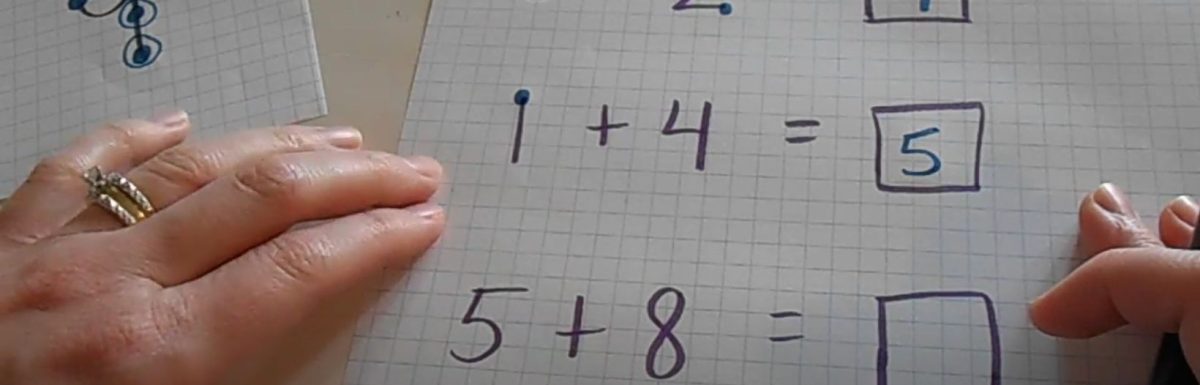
This video is for parents and teachers who would like to learn more about touch math! I was introduced to touch math as I was earning my BS in Elementary Education. It’s a great visual tool to help younger students learn to count, add, and subtract.
My name is Beth, and I am a full-time online math tutor. I am passionate about teaching students all over the world! I created my YouTube channel as a way to help parents when their kids need help with math homework.
A lot of the clients I work with tell me that they don’t understand some of the alternative methods that are being taught these days. Well, I’m here to help with that! I love that there are so many different methods for solving math problems. Students learn in a variety of ways, so why not have a variety of methods?!
🐝 Interested in one-to-one online tutoring?
Transcript
0:01
Hey everyone! We’re going to talk about some Touch Math today. This is for a little bit younger group—kids who are just learning how to count, kids who are just learning how to add single-digit numbers. But it can be a really effective tool, especially for those kids who really need a hands-on approach.
0:19
As you can see, I have my numbers listed here—1 through 9—and they have dots on them corresponding to the number that each digit is worth. So I have three dots on the three, five dots on the five.
0:31
And then these bigger numbers, as you can see, are a little bit different. Instead of drawing six solid dots along the number, we’ve drawn a solid dot in the middle and then circled it with an outer dot. Kids who are learning how to use Touch Math will quickly learn that this means “count it twice.”
0:53
So, in order to count the number six, they would count: 1, 2, 3, 4, 5, 6—and count that way. Same with the seven. Even though the seven is an odd number, as you can see, this dot does not have an outer circle. And kids will easily know how to do that once they start learning how to use this method.
1:12
They will just draw the four solid dots and then continue their counting with the circles around those dots. I’ll show you that when we do some addition here in just a little bit. So this is just the basics—1 through 9.
1:28
Let me show you how to use this in a more practical way with addition problems.
1:31
So your kids will start to learn how to do addition by counting each number. For example, if we have a problem such as 4 + 3, they would count: 1, 2, 3, 4—and put their dots on there. Then they would count: 1, 2, 3—put their dots on the three. Then they can use these dots to add up: 1, 2, 3, 4, 5, 6, 7—and have their answer.
2:02
Once you get a little bit more advanced in learning how to add, you can simply just put the dots on the smaller of the two numbers. We know that this is five, so we can just start with five and count on with the dots that are on the two.
2:18
So we would count: five, six, seven—and just continue adding like that. Once it gets a little bit more advanced, even down here, when you are presented with an addition problem where the first number is the smaller number and the second number is the bigger number, you want to start to teach your kids: “Okay, which one is smaller?” That’s the one that we’re going to count.
2:40
Because we already know that the four is the bigger number, so we can start with four and count on… five.
2:49
And then it works the same down here, even with those larger numbers, like I said, that have the circles around the dots. Your kids will know to make the smaller dots: 1, 2, 3, 4, 5, 6, 7, 8. And then they can use those dots when they’re counting.
3:13
In this case, this is the bigger number, so they would start with this one anyway and count on to five—I’m sorry—count on with five. So it would start with: 8, 9, 10, 11, 12, 13.
3:26
So that’s just a very basic, quick review of how to do Touch Math. Thanks so much for watching!
Extra Credit
If you are looking for other math YouTube videos that pair well with this skill, try these:
🐝Mental Subtraction Tips & Strategies
🐝Addition with Regrouping with base-10 Blocks
🐝Open Number Line Addition and Subtraction


Leave a Reply