

Understanding Scale Factor in Geometry
Hi, I’m Beth from My Tutoring Bee, and today we’re diving into the concept of scale factor—a key idea in geometry that helps us understand how shapes change in size while maintaining their proportions.
If you’ve been following my Pre-Algebra series, you might remember we recently covered how to use proportions to find missing side lengths in similar shapes. Scale factor is closely related, but this time we’re focused on how to scale a figure up or down using a specific ratio.
What Is a Scale Factor?
The scale factor is a number or fraction used to enlarge or reduce a shape. When comparing two similar shapes (like polygons), we use the following formula to find the scale factor:
Scale Factor = (Measurement of New Image) / (Measurement of Original Image)
Let’s walk through a couple of examples to see how this works in practice.
Example 1: Finding the Scale Factor Between Two Triangles
We’re given two triangles: triangle ABC and triangle DEF. The question asks us to determine the scale factor from triangle ABC to triangle DEF.
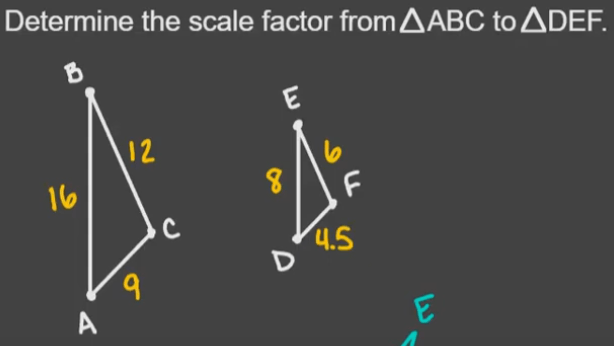
Here’s how to approach it:
- Because triangle DEF is listed second, it’s the original image, and triangle ABC is the new image.
- Choose corresponding sides. For instance, if side DE = 8 and side AB = 16, we can write the fraction as: Scale Factor = 8 / 16 = 1/2
This means the triangle was scaled down by a factor of 1/2.
Example 2: Enlarging and Rotating a Triangle
In this example, we again compare triangle ABC to triangle DEF, but this time the image has been enlarged and rotated.
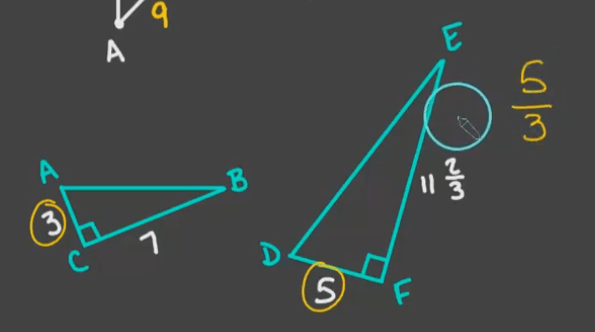
We identify corresponding sides by matching key features, like the 90° angles (angle F and angle C). If one corresponding side is 5 units and the original is 3 units, the scale factor becomes:
Scale Factor = 5 / 3
Even though it’s an improper fraction, we leave it as is. This tells us the triangle has been enlarged.
Example 3: Finding Missing Side Lengths Using a Given Scale Factor
In this scenario, we are given the scale factor and asked to find the new side lengths after dilation.
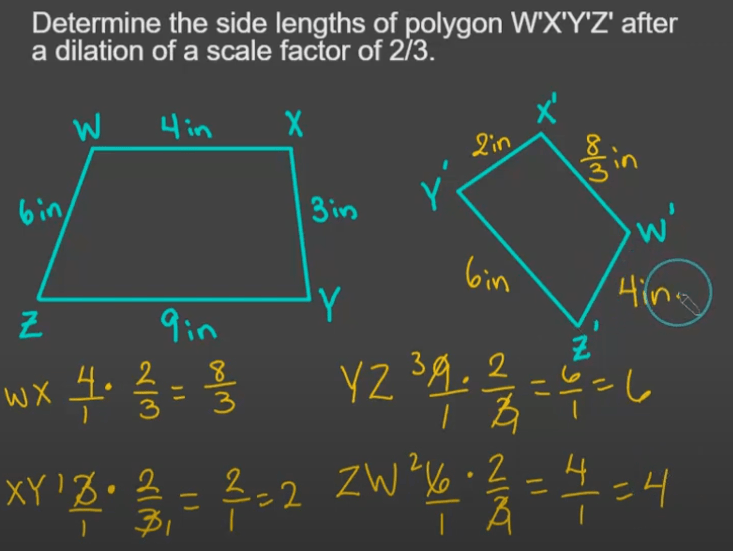
We’re looking at a quadrilateral (trapezoid) named WXYZ, and its image after dilation is labeled W’X’Y’Z’. The scale factor is 2/3.
Step-by-step process:
- WX = 4 in
Multiply by 2/3: 4 × (2/3) = 8/3 in - XY = 3 in
Multiply by 2/3: 3 × (2/3) = 2 in - YZ = 9 in
Multiply by 2/3 (with cross-canceling): 9 × (2/3) = 6 in - ZW = 6 in
Multiply by 2/3 (with cross-canceling): 6 × (2/3) = 4 in
Each new side length gives us a better idea of the dilated shape, which may also be rotated or flipped compared to the original.
Final Thoughts
I hope this walkthrough helped you get a better grasp on how scale factor works and how to apply it in different scenarios.
This lesson is part of my full Pre-Algebra series, which covers everything from basic number sense to more advanced geometry topics. If you’re interested in more lessons like this one, check out the full playlist on YouTube.
Thanks for reading,
Beth from My Tutoring Bee


Leave a Reply