

Introduction: In this post, we will walk through the process of finding the missing side lengths of similar figures using proportions. If you’re not already familiar with proportions, I recommend checking out my previous video where I explain the basics of proportions and how they work.
What Are Similar Figures?
Similar figures are polygons that have the same shape but may have different sizes. They are related by proportionality — the corresponding sides of similar figures are proportional in length, and the angles are congruent (they have the same measure). This property helps us find missing side lengths by setting up proportions.
Step 1: Identifying Similar Sides Using Angles
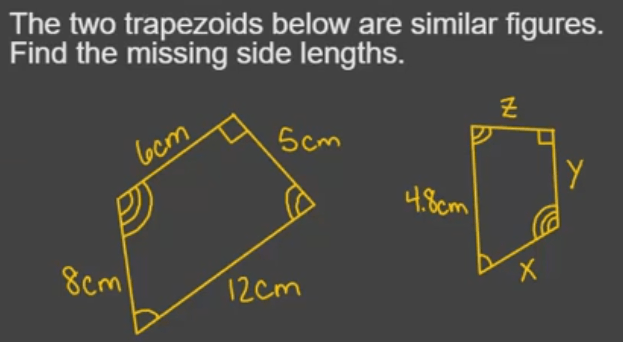
Let’s look at two trapezoids as an example. We are given side lengths for one trapezoid, but only a few side lengths for the second trapezoid. Our goal is to find the missing side lengths of the second trapezoid.
Key Concept:
- The angles in similar figures are congruent, which means corresponding angles in both trapezoids will match up. These angles will help us identify which sides correspond to each other.
Example 1: Solving for the First Missing Side
We begin with two trapezoids:
- The first trapezoid has all four sides labeled with their side lengths.
- The second trapezoid only has one side labeled, and we need to find the remaining three.
Step-by-Step Process:
- Identify Corresponding Sides:
- Start with the side that is labeled in the second trapezoid. Let’s say it’s 4.8 cm. We use the angles to help us identify the corresponding side in the larger trapezoid.
- In this case, the 4.8 cm side in the second trapezoid corresponds to the side in the first trapezoid, as the angles match up (1 arc and 2 arcs).
- Set Up a Proportion:
- Use a table or chart to organize the sides. For example, let’s label the sides as Side A and Side B.
- Set up the following proportion: 12/4.8 = 8/x
- Here, 12 cm and 4.8 cm are corresponding sides, and 8 cm is the other side from the first trapezoid. We solve for x, which represents the missing side.
- Cross Multiply and Solve:
- Cross multiply:
- 12×x=4.8×8
- Perform the multiplication:
- Divide both sides by 12: x=38.4/12 =3.2 cm
- So, the missing side is 3.2 cm.
Step 2: Solving for Additional Missing Sides
Now that we know one side (x = 3.2 cm), we can proceed to find other missing sides, such as y and z.
Solving for y:
- Use the Same Proportion:
- Again, use the ratio between the 12 cm and 4.8 cm sides.
- This time, we are solving for y, and we know that y corresponds to the side in the second trapezoid that is between the 90° angle and the angle with 3 arcs.
- Set Up the Proportion: 12/4.8=6/y
- Cross Multiply and Solve:
- Multiply: 12×y=4.8×6
- Divide both sides by 12: y=28.8/12=2.4 cm
- So, the missing side y is 2.4 cm.
Solving for z:
- Identify Corresponding Sides:
- For the last missing side, z, use the ratio between the 12 cm and 4.8 cm sides once again.
- Set up the proportion: 12/4.8=5z
- Cross Multiply and Solve:
- Multiply: 12×z=4.8×5
- Divide by 12: z=24/12 = 2 cm
- Therefore, the missing side z is 2 cm.
Step 3: Using Polygon Names for Similar Figures
Sometimes, the sides of similar figures are labeled with letters based on the vertices of the polygon. Understanding how to match corresponding sides is essential for solving these types of problems.
- Naming Conventions:
- For example, if two trapezoids are named DEMN and OPQF, we can use the naming convention to match up the sides.
- The first and last letters (D and M, O and P) indicate corresponding sides, and this method can help identify similar sides to set up proportions.
Conclusion:
Using proportions and recognizing the properties of similar figures can help you find missing side lengths. Whether you use a table or diagrams, the key is to match up corresponding sides and apply proportions to solve for unknowns. Keep practicing, and soon you’ll be able to identify and solve these problems with ease!
Related Resources:
- For more on proportions, check out my other videos in the pre-algebra series here!
- Let me know if you found this helpful and if you’d like more tutorials on similar topics!


Leave a Reply